
Pennsylvania In Forma Pauperis (IFP) Application: Guide and Overview
An In Forma Pauperis (IFP) application in Pennsylvania allows individuals unable to afford court costs to proceed without paying filing fees and certain other expenses. Moreover, it applies to civil, family, and some appellate matters in the Courts of Common Pleas and higher courts. However, approval is at the judge's discretion, and courts may deny frivolous cases or if poverty allegations are untrue. Additionally, false statements can lead to penalties under Pennsylvania law.
Pennsylvania uses a standardized process under Pa.R.C.P. 240, with forms varying slightly by county. Furthermore, many counties provide their own versions with instructions.

Pennsylvania Judicial Center in Harrisburg, home to appellate courts including the Commonwealth Court and Supreme Court.
Key Eligibility and Guidelines
- First, you must demonstrate inability to pay without substantial hardship.
- Moreover, courts often reference federal poverty guidelines (e.g., for 2025: $15,060 for one person, plus $5,380 per additional household member).
- However, income slightly above 150% may still qualify with proof of expenses outweighing resources.
- Additionally, attach supporting documents like pay stubs, benefit letters, or bank statements if required.
How to File an IFP Application in Pennsylvania State Courts
- Download the Form: Use your county's form or the general one from PALawHELP.org or pacourts.us.
- Common form: Petition to Proceed In Forma Pauperis (with affidavit).
- Examples: Philadelphia County, York County, or general via https://www.palawhelp.org/resource/petition-to-proceed-in-forma-pauperis.
- Complete the Petition and Affidavit: Provide detailed income, expenses, assets, debts, and dependents.
- File with Your Main Documents: Submit the IFP petition along with your complaint, petition, or appeal.
- Verification: Sign under penalty of perjury (no notary required in most cases).
- Court Review: The judge grants, denies, or partially grants (e.g., payment plan). However, denial is appealable.
- For Appeals: Use Pa.R.A.P. 552-561; file in trial court or appellate court.

Person reviewing and preparing legal paperwork, representative of completing a Pennsylvania IFP application.
Sample Completion (Hypothetical Example)
Disclaimer: This is educational only. Use official forms and your accurate information. Consult legal aid.
Using a typical Pennsylvania IFP form structure (e.g., similar to Philadelphia or general Pa.R.C.P. 240(h)):
- Caption: Court of Common Pleas, [County], [Case Number if known], Plaintiff: Jane Smith vs. Defendant: Landlord Inc.
- Petitioner: Jane Smith (Plaintiff)
- Financial Affidavit:
- Employment: Unemployed (last job ended 11/2025, $400/week take-home).
- Other Income: SNAP benefits ($300/month), no other.
- Dependents: 2 children (ages 6 and 9).
- Assets: Bank account $200; Vehicle worth $4,000 (no loan); No real estate.
- Monthly Expenses: Rent $1,000; Food $500; Utilities $150; Transportation $100; Childcare $300; Total ~$2,050.
- Statement: "I am unable to pay the fees and costs without depriving myself and dependents of necessities."
- Verification: "I verify the statements are true and correct under penalty of 18 Pa.C.S. §4904."
- Prayer for Relief: Request to proceed IFP and waive service costs if applicable.
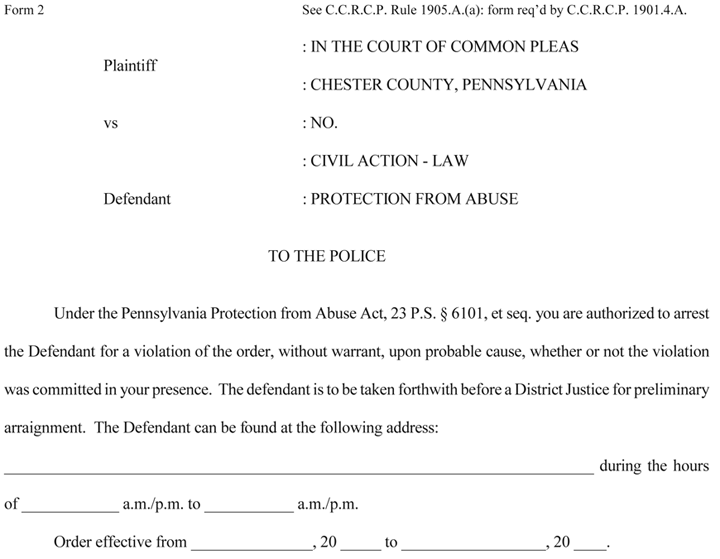
Example section from a Pennsylvania court form, illustrating affidavit details in IFP petitions.
Notary or verification process for legal documents in Pennsylvania courts.
Important Notes
- Moreover, if granted and you later recover money, waived fees may be reimbursed from the recovery.
- However, IFP does not cover all costs (e.g., private process servers in some cases).
- Additionally, for federal courts in Pennsylvania (e.g., Eastern/Western/Middle District), use AO 240 form.
- Therefore, always check your county's prothonotary office or https://www.pacourts.us/ for the latest forms.
- Also, free help available from Pennsylvania Legal Aid Network (palegalaid.net) or county bar associations.
This information is current as of December 31, 2025, and based on Pennsylvania Rules of Civil Procedure and court resources. However, rules can change—verify with the court clerk. This is not legal advice.



0 Comments